
Sealings and Scribes Project
Sealings and Scribes is a collaborative project between AERA and Yale University that studies and publishes thousands of clay seal impressions bearing inscriptions left by people involved in the management and administration of the Heit el-Ghurab site in Giza 4,500 years ago. The impressions date to the Fourth Dynasty (2613–2498 BCE) and offer important information about those who worked on the construction of the pyramids of Giza. The corpus represents a rare, precisely dated, and well-contextualized assemblage of textual evidence from this period. It results from decades of excavations at the site of Heit el-Ghurab, popularly known as the Lost City of the Pyramid Builders, conducted by the Ancient Egypt Research Associates (AERA) team led by Dr. Mark Lehner. This research is carried out in situ in Giza, where the materials are housed. The project also includes a training component for Yale University graduate students, who can spend two weeks in Giza learning how to recognize sealing impressions, reconstruct the compositions of long-lost seals, and register the findings.
The study of seals, and particularly of seal impressions—what we call “sealings”—is still in its infancy in Egyptology. Yet sealing evidence offers considerable potential for understanding how most people engaged with writing and administration in the ancient world. The textual and graphic composition of the original seals can often be reconstructed by piecing together fragments bearing their impressions, which were used to seal different objects. By analyzing and comparing the impressions on the backs of clay sealings—left by papyrus, textiles, basketry, or pottery—it is possible to determine which objects or architectural features were sealed in antiquity. Sealings are thus “daily-life fossils,” impressed with linguistic and pictorial inscriptions on one side and the surface of the object they sealed on the other. Through these uniquely informative double impressions, sealings reveal the everyday activities of scribes, priests, and other ancient Egyptians holding a wide range of titles, from hairdresser to judge.
The project is currently in its earliest phases, focused on analyzing hundreds of unpublished sealings from an area known as House Unit 1 which contains mostly scribal titles. Besides investigating the responsibilities and daily activities of those title holders by determining which objects they were sealing, we also scrutinize the levels of literacy required to actively engage in administrative duties in ancient Egypt by studying both pictorial and textual seals in context. We expect that AERA’s ongoing excavations will reveal additional sealings from other areas.
Project directors:
Prof. Victoria Almansa-Villatoro (Yale University) and Alexandra Witsell (AERA)
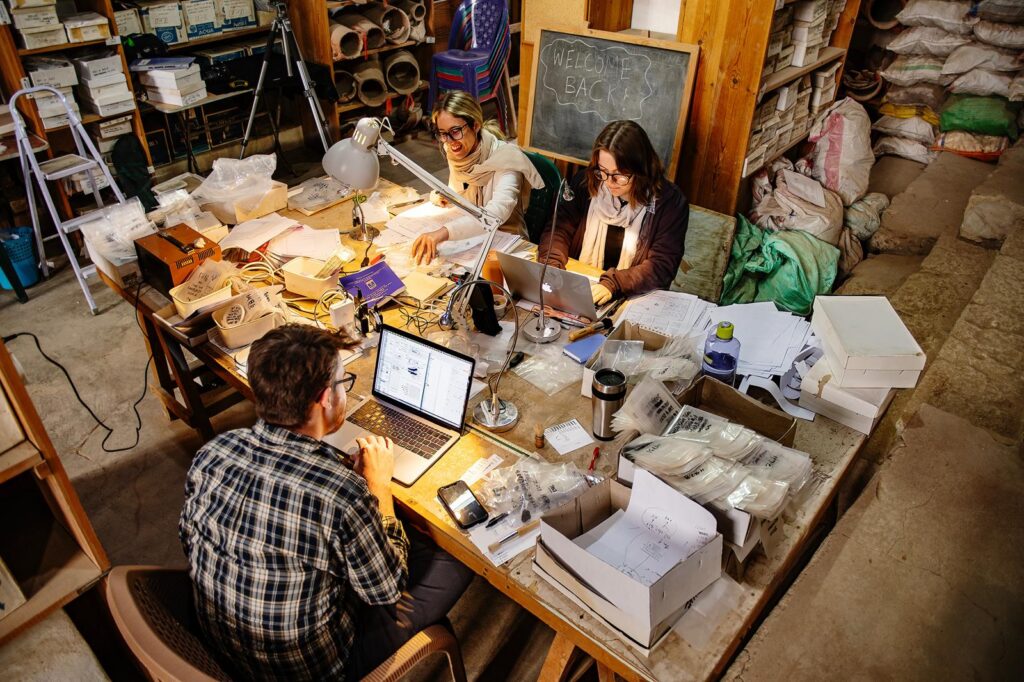
The sealings team at work in the Giza lab.