
Latest News
New Findings from Menkaure Valley Temple
AERA’s 2019 Field Season Report: New Findings from the Menkaure Valley Temple
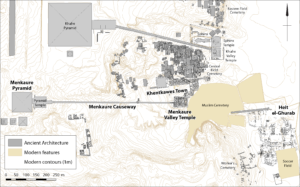
Figure 1: The central-southeastern Giza Plateau showing the location of the Menkaure Valley Temple where we worked during 2019.
The First and Second Temples
During our 2019 Field Season, we returned to the Menkaure Valley Temple (MVT), an area crucial to our understanding of the overall settlement of the Giza Plateau. We believe that when people abandoned the Heit el-Ghurab (HeG) settlement (also known as the Lost City of the Pyramid Workers) they resettled near the Khentkawes Town (KKT) and MVT. The nature of these sites then changed from infrastructures for large royal works to service centers for the cults of the deceased kings.
George Reisner excavated the MVT between 1908 and 1910, but he never saw the whole temple exposed in phase, so his plan of the temple is reconstructed from separate exposures. It was clear to Reisner that he had two major periods: an earlier mudbrick “First Temple” (shown in green on Fig. 2) completed by Menkaure’s successor Shepseskaf and a later “Second Temple” (shown in orange on Fig. 2) built over 200 years later, probably under king Pepi II. Reisner found evidence that a desert flash flood streamed down the northern side of the causeway washing out the center of the First Temple west wall and destroying the portico and offering hall. After this event, the MVT was abandoned. Eventually, people returned and rebuilt the outer wall of the Second Temple roughly over what survived of the outer wall of the First Temple. Late in the occupation of the Second Temple, people built a fieldstone “Water Wall” against the base of the outer wall as protection against further flash floods.
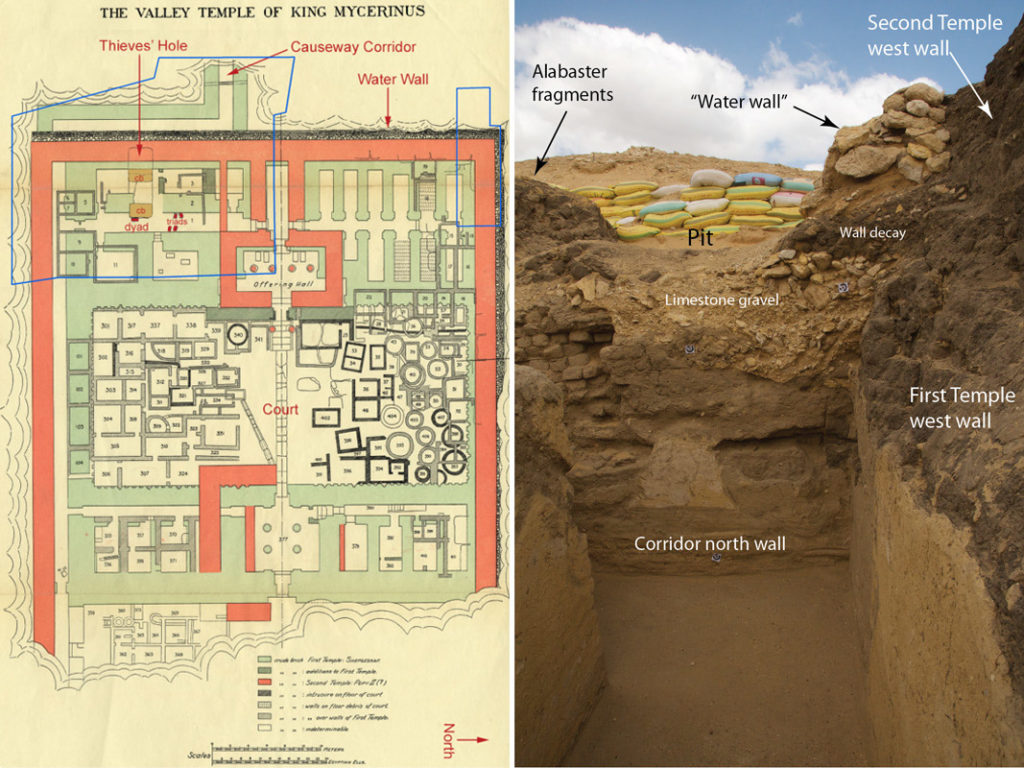
Figure 2: On the left is Reisner’s (1931: plan VIII) multi-phase map with AERA’s annotations. Light green: First (4th Dynasty) Temple, orange: Second (6th Dynasty) Temple, hachured gray: an intermediate phase (5th Dynasty), black: latest domestic structures, blue lines: AERA’s 2019 excavation, cb = core block. On the right is a view from our 2019 excavations inside the MVT after Reisner’s backfill was removed.
Removing Reisner’s Backfill
A good part of our work this year went into removing and examining the deep sand and spoil that Reisner dumped into the back of the MVT and around the surrounding area as he excavated the central court. This central court area was filled with domestic structures, including many bins and granaries, which were built over time on top of each other across the court and up and over the “First Temple” walls (see Figure 2). This area was both architecturally complex and rich in material culture. A short distance north of Reisner’s excavation, we found concentrated deposits of Egyptian alabaster mixed with sand overburden, which extended north beyond our limit of excavation. These spoil deposits were rich in pottery, flint tools, animal bones, ash, charcoal, worked stone (included a diorite beard from a royal statue), pigment, wood, metal, clay sealings, and nearly 100 kg of alabaster statue fragments. Some of the alabaster fragments showed parts of hieroglyphic texts, while others showed traces of blue paint. This deposit is probably where Reisner’s workers sorted the material they found in the court. These finds were overlooked or deemed unimportant in Reisner’s time, but today there is much that we can learn from them.
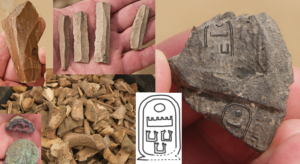
Figure 3: Finds from dry sieving Reisner’s dumps from the excavations of the MVT court settlement. Left: Bones, blades, and a bit of copper. Right: Sealing fragment impressed with a seal that includes the cartouche name of Menkaure. Inset: Menkaure’s cartouche name excerpted from a sealing found in the HeG.
We have yet to fully examine most of the material we retrieved from Reisner’s backfill. However, animal bone and flint tools appear to be, by far, the most abundant material. If this material did come from the apartments in the southern side of the court, the people who stayed there cut a lot of meat. Are we finding the remains of food ritually offered to Menkaure and then consumed by people in the service of his temple? Further work in our lab may help us find out.
Descending into the Thieves’ Hole
After we had removed Reisner’s backfill, our attention then turned to what he called the “Thieves’ Hole.” This is where Reisner discovered the Menkaure dyad, before being stopped from going further by the rising ground water. Given our limited time and resources, we focused on removing Reisner’s fill within his retaining walls to reach the bottom of the hole, which gave a valuable cross-section of the stratified architecture of the temple.
As we descended we were astounded by the great depth of this part of the temple and the massiveness of the First Temple walls. We found two large limestone “core blocks,” so-called because they were meant to form the cores of the walls, which the builders would later sheath in hard granite. This is evidence that Menkaure wanted to build a stone temple, like Khafre’s Valley Temple, but the stonework stopped, probably when he died, and the temple was completed in mudbrick.
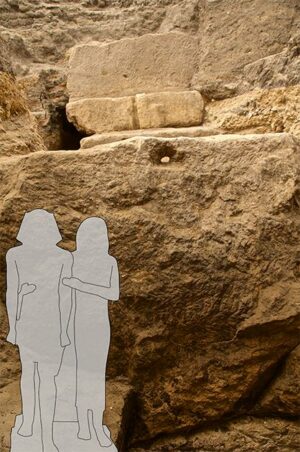
Figure 4. An outline of the dyad statue in the approximate position where Reisner’s team found it standing upright and practically undamaged on January 18, 1910. View to the west.
Further to the east inside the Thieves’ Hole, we found another large limestone core block. In front of this block is where Reisner discovered the famous nearly life-sized statue of Menkaure and a woman, probably the queen mother, standing upright and nearly undamaged (except for a chip off the king’s beard). This dyad statue, on display at the Museum of Fine Arts in Boston, is one of the most magnificent sculptures in world art history. Reisner’s explanation that the Thieves’ Hole had been “dug by treasure-hunters of the Moslem Period” and that the dyad was “apparently thrown into the hole by the treasure-hunters before they began the next hole on the west” did not add up as we now looked at the evidence 109 years later. Why would robbers leave the dyad until later and why would they sink it so deep under the temple floor? How did the dyad remain so relatively undamaged if it was thrown in?
A New Theory Emerges
Our archival research and this season’s excavations have led us to realize that Reisner did not actually find the dyad in the Thieves’ Hole at all, but in a deeper, older hole, that someone dug in ancient times a little farther east. AERA senior archaeologist Dan Jones came up with this important finding from a meticulous review of Reisner’s published report, unpublished diary, and photographs, all available at The Giza Archives.
On January 16, 1910, Reisner wrote in his diary “(n)ext to the thieves’ hole…there is another hole filled with such debris (yellow gravel) that it also must be a thieves’ hole.” In all later reports Reisner conflated the two conjoined holes, but a close study of his photographs along with our new excavation leads us to believe the Thieves Hole and the “dyad hole” are indeed different features. The older dyad hole appears to have been started from the surface of the ruins of the First Temple. That is, someone dug this hole down into the crushed limestone foundation of the First Temple during or after it fell into ruin, perhaps soon after the flash flood destroyed the sanctuary.
It now appears that the Menkaure dyad may have been buried long before the Thieves’ Hole was dug and that this older dyad hole was intentionally dug expressly for placing the undamaged statue upright, for safe keeping deep inside the temple foundations. Why this was done, and who and what the dyad represents, must await further discussion. When we return to the deep end of the MVT for our 2020 Field Season, we hope to find more answers.
Our 2019 Season was made possible thanks to the generous support of Dr. Walter Gilbert, the American Research Center in Egypt (ARCE), and AERA’s members and donors.
AERA members will receive more information on our work at the MVT in future AERAgrams. Join AERA now to help support our ongoing excavations in Egypt and you will receive these publications as soon as they are published.
Watch AERA’s 2019 excavations at Menkaure Valley Temple
A CNN crew joined our team in March to document what it was like working on the Menkaure Valley Temple in Giza. This is the first video footage from the western part of the Temple, which until this year had been buried under sand since George Reisner last saw it 100+ years ago.
The video documents some of our recent finds, details our approach to archaeological science, and interviews some of the incredible team of people working with us from Egypt and around the world. We are so happy to be able to share this video with our members!
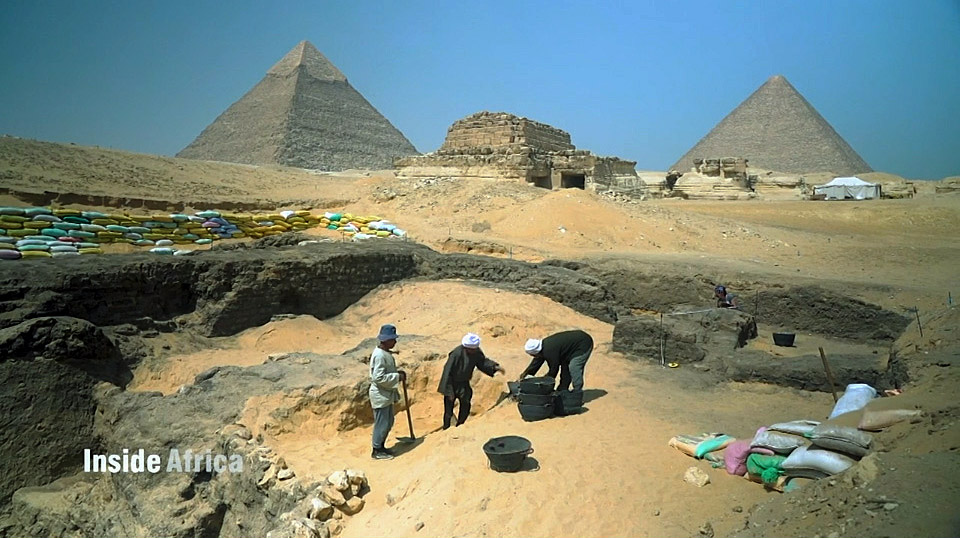
CNN’s Inside Africa documented our 2019 excavation as part of a program on Egyptian archaeology that also features recent finds at Saqqara and ARCE’s field school program.
New book by Dr. Malleson “The Fayum Landscape”
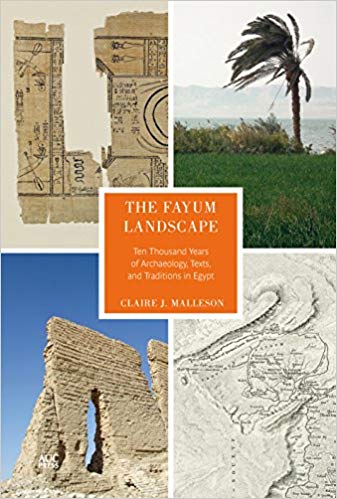 We are pleased to announce that Dr. Claire Malleson, AERA’s archaeobotanist and Giza lab manager, has published her first book. In addition to her work at Giza, Dr. Malleson has been working in the Fayum for many years and her book focuses on the history of this important region.
“Located some one hundred kilometers southwest of Cairo, the Fayum region has long been regarded as unique, often described in terms that conjure up images of an idealized Garden of Eden. In An Egyptian Landscape, Claire Malleson takes a novel approach to the study of the region by exploring the ways in which people have, through millennia, perceived and engaged with the Fayum landscape.
Distinguishing between the experienced landscape of state and bureaucratic record and the imagined landscape of myth, meaning, and observers’ personal influences and expectations, Malleson questions in detail where those perceptions come from. She traces religious practices, follows the tracks of myths and traditions, and investigates the roots of stories found in texts from the pharaonic, classical, and Medieval Islamic periods. She also reviews many, more recent travel writings on the region from the seventeenth to the nineteenth centuries. The work of each author is presented in its historical and cultural context, and Malleson integrates what is known about ancient activities in the Fayum, based on the archaeological evidence from the many monuments and ancient settlements that exist in the region.”
2019 Season Begins at Menkaure Valley Temple & Sphinx
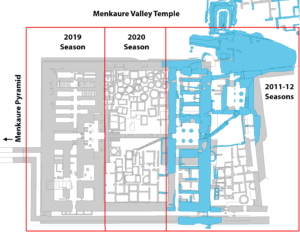 Our excavation season has just begun and we’re starting to peel back the sand that George Reisner left to cover and protect the Menkaure Valley Temple (MVT) ruins after excavating it more than 100 years ago. It’s exciting to take a look at this site with modern archaeological methods, especially since Reisner backfilled as he excavated and the western part of the site remains much as he found it and unseen since 1910.
We return to the MVT this year thanks to the support of Wally Gilbert, Nobel Laureate in chemistry and a founder of Biogen. Our focus is the western third, the location of the inner sanctuary and its flanking magazines. This is where Reisner found the world-renowned Dyad and Triad statues of Menkaure flanked by his queen, the goddess Hathor, and deities of Egypt’s nomes (districts). We previously excavated the eastern third of the MVT and its Annex and when we return in 2020, we will tackle the more complex settlement archaeology in the central court, where temple personnel built apartments to live in and granaries to hold their shares of temple revenues.
While our excavation team works in targeted trenches at MVT, our team of material culture specialists will be making their own exciting discoveries in AERA’s field lab, nestled among the gigantic mastaba tombs west of the Great Pyramid. In the lab we will be continuing our exploration of the oldest phase of the Lost City of the Pyramids through the analysis of material from the Kromer Dump site.
Last season, we collected hundreds of bags of cultural material, mostly from the lower, older phase of dumping that came from the direction of the Lost City site. While much of it still waits to be examined this year, we’ve already seen evidence of a high-status building, possibly a palace from the time of Khufu that Khafre’s workers demolished in order to create the phase of the Lost City that we have seen so far. This dumped material includes painted plaster, cattle bone, and sealings with high-ranking titles. One especially intriguing sealing mentions the Setep Za, one of the terms for the royal entourage and palace.
With Dr. Zahi Hawass and the Glen Dash Foundation, in March we will also return to the Great Sphinx of Giza. In 2018 we began a survey of the Sphinx using new technologies to gather information that has come to light since the 1979-1983 ARCE Sphinx Project directed by AERA’s Mark Lehner and James Allen. This year we will focus our conventional and geophysical survey on the mysterious Sphinx Temple, which lies to the east, below the Sphinx’s giant outstretched paws.
We are excited to be back in Egypt and look forward to sharing our new findings with you!
From Our Students: Learning Animal Bone
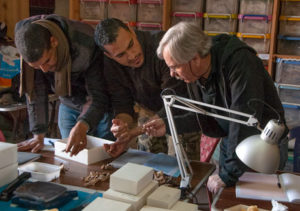
In the AERA Field Lab Richard Redding teaches Mohamed Hussein (far left) and Mohamed Raouf the basics of archaeozoology as part of the AERA Advanced Field School. Photo by Mark Lehner.
Editor’s Note: As AERA continues its mission of education and outreach, we delight in sharing our staff’s knowledge with new generations of students and scholars. This is especially rewarding when we have the chance to delve more deeply into an area during an Advanced Field School session with students who have a passion for a particular topic. Here, two students of AERA’s archaeozoologist Dr. Richard Redding, Mohamed Hussein Ahmed and Mohamed Raouf Badran, share their experiences and impressions of their training during the Giza 2018 field and lab season. We feel that the best way to train students is a hands-on approach to our current research topics. Mohamed and Mohamed did just that, jumping right in on new material from that season’s excavations at the Kromer Dump Site.
Become an AERA member or make a donation to help us continue training the next generation of Egyptian archaeologists. Your contribution helps provide supplies, equipment, and staff salaries for our field school program.
by Mohamed Hussein Ahmed and Mohamed Raouf Badran
The 2018 AERA-ARCE Field School training was a dream come true. It is important that people know that becoming an animal bone specialist in Egypt is not an easy thing. To even find such training in a university in Egypt is difficult, if not impossible. Both of us had an urgent need for this specialist training right now, as we are both working on our theses, and animal bone is a key component of our topics.
We each had an interest in animal bone and the information we can receive from studying it before we came to the field school. We both knew of Dr. Redding through his writings or his lectures, but there was not a chance to have this one-on-one specialist training with him. During our research, we would send emails to Dr. Redding asking for copies of articles or books, advice, opinions, or other help that we needed in our work, but it was not enough. It was hard to read the articles and understand them because they were full of difficult Latin terms and scientific abbreviations, and we needed help just to understand the specialist language. We told Dr. Redding we would be eager to have in-depth training, and he worked to make it possible during this year’s excavation season.
Overview of Our Work
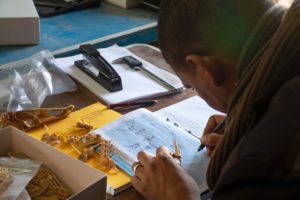
Mohamed Raouf draws fish vertebrae from Richard Redding’s reference collection. The inset shows the vertebrae.
Over six weeks of intensive training, Dr. Redding gave us all the support we needed—comprehensive explanations, articles to read, reports and references to use in writing, tools for our future work, and practical applications and demonstrations through magnificent research trips that helped us in understanding archaeozoology. He used different ways of teaching, like his great presentations with the white board, his unbelievable comparative collection in the lab, regular exercises to test our identifications, using manuals for mammals, birds, and fish, and training in equipment like scales and calipers.
He began with a general introduction about the mammals, birds, and fish of ancient Egypt. Then he focused on the most common of each category that we might find archaeologically in our future work. It was not easy for us at the beginning as we received a good deal of new Latin and English terminology in this course, but Dr. Redding did his best to deliver the information with his easy approach. By the end of the course we were on the same page, meaning that we succeeded in understanding these very difficult Latin words even if we did not know their Arabic meaning.
By the end of the first two weeks of training we were not only able to identify small fragments of bird and fish, but also which part of the body they came from. Dr. Redding’s vast comparative collection played an important role in identifying the fish. Ancient Egyptians caught many types of fish, and without the comparative collection we would face difficulty in identifying it. This is especially true with the very small fragments of bone recovered from the wet-sieve process, where the soil from excavation is washed through a series of fine sieves after it is rough-sifted on site. But, with practice, we were able to identify the more common fish without using the comparative materials, in particular those of catfish and Nile perch.
For mammals, we quickly set to work identifying the fragments of cattle, sheep-goat, and pig. With more training we moved to more advanced tasks, like identifying sheep from goat, determining male from female, and recognizing the fusion on some elements of the bones. One amazing thing is that we were able to differentiate between the milk teeth and the permanent teeth by studying the eruption process, and we learned how to differentiate between herbivores and carnivores by their teeth!
Within this intensive course we learned the name of each bone in the body; we were able to recognize if a bone fragment is from the right or left side of the body; and we learned the terminology to describe bone fragments and their condition in the appropriate ways. By the end of the course we were able to give our own interpretation about the faunal remains that we identified and recorded. We enjoyed every moment of this training.
Beyond the Basics
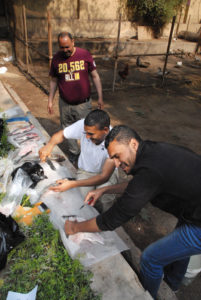
Preparing fish for the skeletonizing process—the first step in making their own comparative collections. Mohamed Hassan, AERA Lab Assistant and a fish expert, stands ready to advise.
We started our real work by identifying faunal remains from the BBHT area of the main site. We did our best, but unfortunately the bone fragments from this area are small, very fragmented pieces. By this time, Dr. Redding had begun to receive the bone from the new Kromer excavations. He was very excited at how complete and numerous these bones are. When we saw the Kromer bone, we were both thinking how great it would be to work on this material, so we asked, “Can we work with you, Dr. Redding, on the Kromer bone?” And he answered “Yes, of course!” We were very happy to work on such amazing and unique material, and started working right away with him to identify and record the faunal remains from the Kromer excavations.
Unfortunately, after four weeks Dr. Redding had to leave to return to the US. But the work continued as if he was still with us. Dr. Mark Lehner visited us almost every day, following and supporting us, and asking questions and taking photos. We were very happy that they relied on us to complete the work. We did it together through good cooperation. Together we succeeded in identifying, recording, and entering the information in the database. Together we wrote and sent our weekly reports to the other AERA staff, and we even began to write the final report of this season.
Field Trips
Outside of the lab, there were other activities that we also found very informative. The weekly site tours of the ongoing work at the Kromer, Lost City, and Khentkawes Town sites helped us have a better understanding of each area, which is important for our interpretations in the final faunal report. Many research trips were arranged for us. These were diverse and covered several aspects of archaeozoological work, including visits to the Giza Zoo and Zoological Museum, the Giza Fish Market, the tombs of Saqqara, and a scientific conference where Dr. Redding presented a paper on the material from the Heit el-Ghurab site.
A Trip to the Zoo
While we were learning mammals we took a trip to the Giza Zoo, where we had a good chance to see many of the animals we may find in the archaeological remains of Egyptian sites. We had a good overview from Dr. Redding on animals like lions, tigers, giraffes, monkeys, and birds.
The trip also included a short visit to the Zoological Museum—a great museum with many animal skeletons on display. It was a very interesting and important visit for us. We talked with the Zoological Museum’s manager about their collection and where and how they obtain the skeletons for the museum. Seeing such a large collection, we wondered if it would be possible for us to practice with and study this bone in the future. It would be a great opportunity for us to handle and identify these different animal bones, especially the animals that we might encounter archaeologically. In thinking about that, we approached the Ministry of Antiquities about having a joint understanding so that we might work with the Zoo and the Zoological Museum for future study. The Ministry agreed and we now have an approval letter for future cooperation. We made a good connection with the Zoo and museum staff, and found them very friendly and helpful.
Fish Week
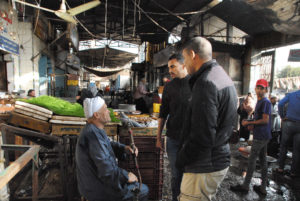
At the Giza Fish Market, Mohamed Raouf (left), and Mohamed Hussein have a conversation with the head of the market about the price of fish and patterns of consumption.
Fish week was both wonderful and difficult because we received so much information about fish that we needed more time than the one week allowed. We discovered that “fish” are not only the five common types of fish that we consume in modern Egypt, but that it is a big tree or a whole community of fish that we did not know about before this field school. Dr. Redding explained to us the different types of fish, their families, species, and sex, and many other facts about the science of fish. Then we started to learn the most common species of fish that are found archaeologically and how to identify the bones recovered from the site using the AERA comparative collection.
Dr. Redding arranged a fantastic trip to the Giza Fish Market. There we saw different types of Nile fish that are commonly found in archaeological sites, and some marine fish as well. We were fortunate to be guided by Dr. Redding as he gave us information for each kind of fish in the market. At the end of our trip he selected various kinds of fish for us to start our own comparative collections.
We spent a half day in the fish market before returning to the AERA-Egypt Center to begin skeletonizing fish for our collections. We skeletonized our fish by removing as much of the meat as possible without damaging the bones, then sealing the remnants in a container with flesh-eating beetles that will finish the work on the more delicate pieces. Dr. Redding brought out knives, saying “Start now to remove the meat carefully, keep the bones as they are, and skeletonize your own fish comparative collection.” We did this work with our own hands, and enjoyed it very much. After we finished the cleaning process, we hung the fish in the garden of the villa for a couple of days while waiting for the beetles to come, and then we saved the fish in a closed box. This process might take three months or more, depending on how fast the beetles work.
The market trip and this skeletonization process that we made had given us a great help and is key to learning the anatomy of the fish skeletons and developing our skills for differentiating the most common species of fish we would find archaeologically.
Researching in Tombs
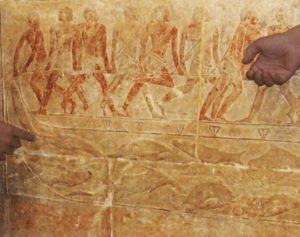
A scene of fishermen hauling their catch from the Tomb of Mereruka at Saqqara. The students were surprised that the depiction of the fish was so accurate they could identify them.
Dr. Redding also arranged an important field trip for us to visit Saqqara to see the tombs of Kagemni, Mereruka, and Ty. These three tombs are very rich in fish and fishing illustrations and show many of the same types of fish we had seen in the Giza Fish Market. Also there we examined the fish scenes and recognized the fish of the pharaohs from their representations.
We met Rasha Nasr, Archaeozoologist, and a student of Dr. Redding’s from the 2010 AERA-ARCE Field School. She offered us great help in visiting the tombs and also visiting the site of the excavations there, where they found a large amount of both human and animal bone, including dog mummies. Dr. Redding discussed with us how to deal with and study the dog mummies, including how to preserve them for the future.
Attending the “Food and Drink” IFAO Conference
Dr. Redding also supported our academic progress. He took us to a scientific conference titled “Food and Drink in Ancient Egypt and Sudan,” held at the Institut Français d’Archéologie Orientale (IFAO) and the Polish Center of Mediterranean Archaeology in Cairo. There were great lectures based on the faunal and floral remains found at various sites. In addition to learning a great deal about ancient food and drink, we had opportunities at the conference to mix and mingle, form new relationships, and strengthen existing ones.
Filming
During this training we also participated in filming with Dr. Redding and Dr. Lehner. They encouraged us to speak on camera, and we both had an interview with an ARCE film crew to be shown in ARCE’s 2018 Annual Meeting in the US. We were happy to answer the questions of Dr. Louise Bertini, the Director of ARCE Egypt, about the field school training and how we benefitted from this course. Both Dr. Redding and Dr. Lehner encouraged us to speak in front of the camera, and this helped us to feel confident in doing so.
Acknowledgments
We would like to express our gratitude to our great teacher, Dr. Richard Redding, for his support, patience, and encouragement throughout this field school. It is not often that one finds a teacher who always finds the time for listening. We greatly appreciate all that he has done for us. He put us on the right track with a great amount of help, and trusted us with his own tools and comparative collection. Our thanks also go to Dr. Mark Lehner for closely following our training, providing many valuable comments, and sending helpful materials that improved our work. We are grateful for his support.
We would also like to show our gratitude to Dr. Bassem Gehad, Assistant to the Minister of Antiquities for Capacity Development and Human Resources. We also thank Dr. Mohamed Ragaey, the General Director of the zoos all over Egypt for his offer to study any skeletons in the museum, and Dr. Mervat, Director of the Zoological Museum of the Giza Zoo, for her hospitality and cooperation.
Mohamed Hussein Ahmed is working on the faunal remains from the Early Dynastic-period bone from the South Abydos excavations and is a student at South Valley University. He serves as the archaeozoologist for the South Abydos Excavation, Early Dynastic Cemetery and Settlement (SAEEDCS) Project, and after the conclusion of this year’s work was named the head of the archaeozoology department of the Scientific Center for Archaeological Field Training of Upper Egypt.
Mohamed Raouf Badran is a student at Mansoura University in the Department of Egyptology, where he is writing his thesis on nutrition in workmen’s communities in ancient Egypt. Following the training with Dr. Redding, he participated in another in-depth AERA-ARCE workshop on archaeological data management. He is currently an Inspector at the Giza Pyramids Inspectorate.
Become an AERA member or make a donation to help us continue training the next generation of Egyptian archaeologists. Your contribution helps provide supplies, equipment, and staff salaries for our field school program.
The Giza Botanical Database Goes Online
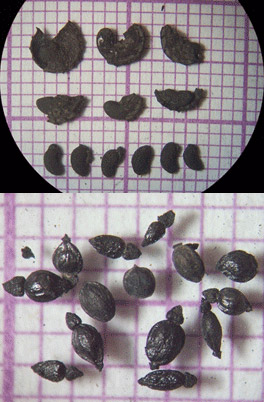
Since 1988 Ancient Egypt Research Associates has systematically collected sediment samples for flotation in order to recover macrobotanical remains from project excavations in Old Kingdom settlements on the low desert to the southeast of the Giza Plateau, Egypt. The goal has been to contribute information on ancient plant use to the project research. This dataset contains all samples studied between 1988–2018. Site conditions at Heit el-Ghurab fluctuate between wet and dry (and have done so for millennia), and therefore only charred plant remains are preserved. Despite the drier conditions of the Khentkawes Town, only charred remains are preserved there as well.
The remains come primarily from two different settlement sites—the Khentkawes Town and Heit el-Ghurab. Within the Heit el-Ghurab settlement there are three distinctly different neighborhoods—the Western Town (large dwellings), the Eastern Town (small village-like dwellings), and the Galleries (a walled area possibly designated for communal accommodation for work and expedition crews). The Khentkawes Town was initially constructed to house priests attached to the funerary cult, but later was probably re-purposed. Information about archaeological features varies for different areas of excavation due to evolving standards of site recording over 30 years.
Dr. Wilma Wetterstrom initiated botanical work at the site. In 1995 the project expanded and Dr. Mary Anne Murray took over. In 2007 Claire Malleson joined as assistant, and in 2012 took over as lead botanist. Trainees have included Mennat-Allah El Dorry, Rebab el-Gendy and Essam Ahmed Soliman.
The Giza Botanical Database project was designed to make this data publicly available for the first time. The work conducted between July 2017–June 2018 focused on data “cleaning.” It included the following:
- Human errors in the database were corrected via a cross-check with the AERA site database (for example, obvious misread/miswritten and mistyped feature or bag numbers, such as “0” instead of “6,” “1” instead of “7”).
- Area codes that had been updated in post-excavation work were corrected based on cross-checks with AERA site database and AERA GIS. This document provides a summary description of areas as well bibliographic references.
- Feature information was updated using the AERA database and the AERA GIS.
- The format of the unique ID for samples (the Master_Sample_Number) was made consistent throughout.
- All botanical identifications were corrected based on updated information. For example, where we had grouped similar unknown items (for example “Trifolieae type A/B/C or D”) when we first encountered them, we later successfully identified these items, but had not necessarily updated the database. In these instances the database was corrected to show the correct identification).
- Botanical terms were updated to reflect accepted international changes in nomenclature/taxonomy (for example, Graminae became Poaceae, Leguminoseae became Fabaceae). It was decided to retain the older names in the records due to the fact that not all student / trainee archaeobotanists are aware of, or familiar with these changes. Some archaeobotanists prefer to retain the older terminologies.
- Field notebooks were cross-checked with the database; corrections were made, and any missing samples were added.
- In addition, the archive (all field notes of flotation and identifications) was updated and stored as hard copies in Boston and Giza, and as digital copies on the AERA server and a dedicated external hard drive.
AERA discovers two ancient houses near Giza pyramids
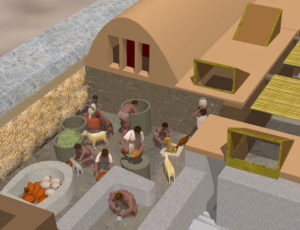 AERA’s discovery of two ancient homes near the Giza pyramids in Egypt was reported this week in LiveScience.
The houses were located near an ancient port that saw goods and materials coming in from all over Egypt and the eastern Mediterranean. The structures may have housed officials responsible for overseeing the production of food for a paramilitary force living in a nearby series of galleries, during the time the Pyramid of Menkaure was being constructed at Giza.
For more information, including a photogallery of images, see the full article on LiveScience.
For our reports of previous seasons’ work at these structures, see AERAgram volumes 16 & 17.
Mark Lehner interviewed by CNN
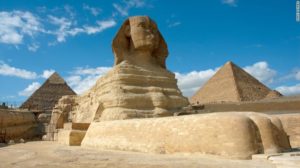 Dr. Mark Lehner was interviewed by CNN about his new book, Giza and the Pyramids, and about his decades of work on the Giza Plateau. He discusses how he got his start studying the Great Sphinx, alternative theories, and the recent discoveries at Wadi al-Jarf.
Read the complete interview on CNN.
ARCE Sphinx Project 1979-1983 Archive
The ARCE SPHINX PROJECT (1979-1983) aimed to produce scale drawings (plans and elevations) of the Great Sphinx of Giza, where no scale drawings of this unique monument had been produced before, to map the greater Sphinx site, including three ancient Egyptian temples situated east of the statue, and the larger quarry forming the Sphinx “amphitheater.” Objectives included elevations, profiles, and a detailed master plan of the Sphinx, detailed section and profile drawings showing the masonry restorations added to the statue, topographical maps of the Sphinx ditch and larger quarry, and maps of the structural geology of the site, showing stratification and faults.
The idea was that we could achieve a better understanding of the origin of the Sphinx and how the 4th Dynasty Egyptians created the Sphinx from careful, recorded observations of its structure and geology, and that a good part of the history of the Sphinx could be read from detailed survey and mapping of the stratified masonry on the Sphinx, and from the condition of the bedrock core under the earliest masonry, as well as from analysis of tool marks and mortar bonding the different phases.
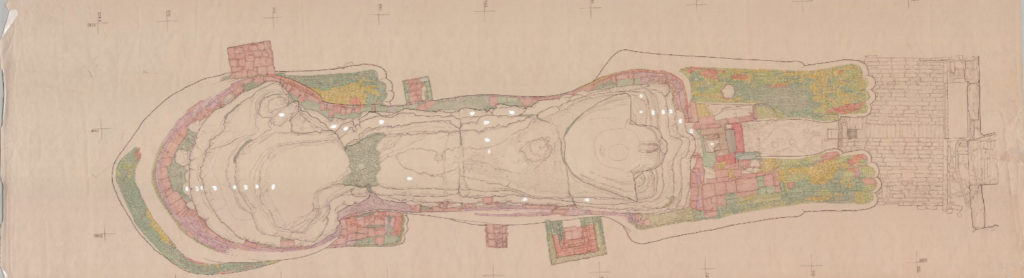
An image from ARCE Sphinx Project 1979-1983 Archive.
Dr. James Allen, then Assistant Director of the American Research Center (now Charles Edwin Wilbour Professor of Egyptology at Brown University) applied as Project Director to the Egyptian Antiquities Organization to survey and map the Sphinx. Mark Lehner served as Field Director. Ulrich Kapp (German Archaeological Institute in Cairo) carried out the photogrammetric survey and plotted the master profiles and elevations of the Sphinx. Team members included Christiane Zivie-Coche (Director, Centre Wladimir Golenischeff, École Pratique des Hautes Études, Egyptology), Attila Vass (survey), Susan Allen (now, Museum of Fine Arts, Boston, survey), Peter Lacovara (then Museum of Fine Arts, Boston, now The Ancient Egyptian Egyptian Heritage and Archaeology Fund, survey) and Cynthia Schartzer (archaeology, survey), K. Lal Gauri (University of Louisville, geology), and Thomas Aigner (University of Tübingen, geology).
The ARCE SPHINX PROJECT ARCHIVE includes written, drawn, and color slide photographs and black and white photographs. Drawings include:
- Master elevations of the front and sides of the Sphinx, scale 1:50,
- Master plan of the Sphinx, scale 1:50,
- Detailed maps of the 4th Dynasty Khafre Valley Temple, the Sphinx Temple, and the 18th Dynasty Amenhotep II Temple, scale 1:100,
- Topographical and geological maps of the wider Sphinx “amphitheater,” scale 1:200,
- 1:1,000 map of the Sphinx and modern installations to the East as of 1979,
- Detailed architectural sections and elevations of the stratified ancient masonry layers applied to the Sphinx bedrock core body, scale 1:20 and 1:10,
- 5,000 slides,
- 2,716 black and white photographs,
- Profile of the Sphinx area with water table measurements taken during 1981-82.
Click here to find out more about the ARCE Sphinx Project Archive.
Click here to start browsing the Sphinx data.
“Giza and the Pyramids: The Definitive History” out now
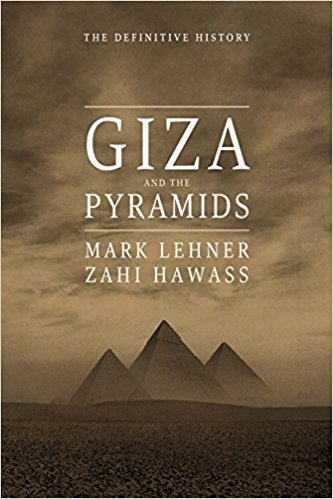 In this new book Mark Lehner and Zahi Hawass provide insights into the history of the Giza plateau based on more than 40 years of excavating and studying the site.
Though today the pyramids and the Sphinx rise from the desert, isolated and enigmatic, they were once surrounded by temples, vast cemeteries, harbors, and teeming towns. This book describes that past in vibrant detail, along with the history of exploration, the religious and social function of the pyramids, how the pyramids were built, and the story of Giza before and after the Old Kingdom. These monuments are brought to life through hundreds of illustrations, including photographs of the monuments, excavations, and objects, as well as plans, reconstructions, and images from remote-controlled cameras and laser scans.
“Lehner and Hawass have produced an astonishingly comprehensive study of the excavations and scientific investigations that have, over two centuries, uncovered the engineering techniques, religious and cultural significance and other aspects of the Giza site.” Read the full review in Nature.
Available now on Amazon or wherever books are sold.