
Latest News
AERA’s Field School Celebrates 10 Years in Egypt
On March 21st, AERA celebrated the 10th anniversary of our field school program in Egypt with a party at the AERA-Egypt Center in Giza. Many of our graduates attended the celebration alongside current students, staff members, and officials from the Ministry of Antiquities.
We wish to thank the Egyptian Ministry of Antiquities, USAID, The American Research Center in Egypt, and The American University in Cairo for their generous support and co-operation over the past ten years. We look forward to celebrating another ten years of training the next generation of Egyptian archaeologists in 2025!
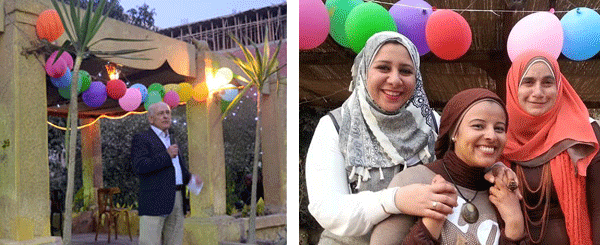
Dr. Mark Lehner speaks at the field school anniversary party (l); current and former AERA staff members, students and instructors celebrate at the anniversary party. (r).
The Pig and the Chicken in the Middle East
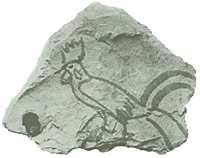
A chicken on a limestone fragment found by Howard Carter in front of Tutankhamun’s tomb.
Sometime around 1000 B.C.E. pig use in the Middle East declined and was subsequently religiously prohibited. Around the same time that pork fell out of favor, chickens were introduced into the area.
AERA Chief Research Officer Dr. Richard Redding’s paper examining the historical reasons for the decline of the pig (and the rise of the chicken) has been featured in the Smithsonian and the New Historian.
The full text of his article, The Pig and the Chicken in the Middle East: Modeling Human Subsistence Behavior in the Archaeological Record Using Historical and Animal Husbandry Data, is available in the Journal of Archaeological Research.
Abstract: The role of the pig in the subsistence system of the Middle East has a long and, in some cases, poorly understood history. It is a common domesticated animal in earlier archaeological sites throughout the Middle East. Sometime in the first millennium, BC pig use declined, and subsequently it became prohibited in large areas of the Middle East. The pig is an excellent source of protein, but because of low mobility and high water needs, it is difficult to move long distances. While common in sites, the pig is rarely mentioned in texts. In contrast, the use of cattle, sheep, and goats is extensively documented. In the human subsistence system of the arid and semiarid areas of the Middle East, the pig was a household-based protein resource that was not of interest to the central authority. Sometime in the late second or first millennium BC, the chicken was introduced into the Middle East. The chicken is an even more ideal household-based protein resource and, like the pig, is rarely mentioned in texts. In arid and semiarid areas of the Middle East, the pig and the chicken compete for food and labor in the human subsistence system. I hypothesize that in arid and semiarid areas of the Middle East, the chicken largely replaced the pig because the chicken is a more efficient source of protein, it produces a secondary product, the egg, and it is a smaller package; hence, a family can consume one in a day or two. This made the pig redundant and available for use in other human systems. The pig, however, never disappeared from the diet of humans in the Middle East.
The full article is available in the Journal of Archaeological Research.
Season’s Greetings from Giza
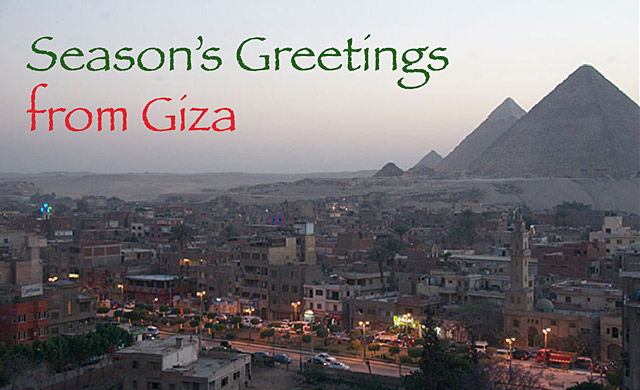
Wishing you Happy Holidays and a prosperous and peaceful New Year
from the whole AERA team
From exploring Egypt’s ancient cities to training the next generation of Egyptian archaeologists, AERA’s work is made possible thanks to the support of our members.
We need your help to explore further.
The AERA team devoted much of 2014 to bringing together 40 years of information to create new reconstructions of the pyramid builders’ urban architecture and water transport infrastructure. Now we look forward to 2015. In eight weeks we begin new excavations and an international field school at the Lost City of the Pyramids.
AERA’s accomplishments are possible thanks to the support of a science-minded community of interest in ancient Egypt. As a member of that community, you make possible AERA’s discovery and training on a scale that would not be possible within a large institution.
Using our unique opportunity at the Giza Pyramids for field research, AERA continues to lead in archaeological training and cultural exchange. While reconstructing the past, we also establish relations throughout contemporary Egypt at a grassroots level to help build a future for Egyptian archaeology.
Help us keep our field programs vital and effective. Think of us in your year-end giving by donating to AERA, giving a gift membership, or by directly sponsoring an area of our research through our giving catalog.
Thank you to everyone who helps to make our research possible!
Sincerely,
Mark Lehner
President, Ancient Egypt Research Associates
View the First Photos Taken from the Great Pyramid Summit
The animation below shows the first photograph taken from the summit of the Great Pyramid, a stereoview photo taken by E.L. Wilson in 1882. This photo also provides the first photographic record of the site where the Lost City of the Pyramids settlement (Heit el-Ghurab) lay buried under 2-6 meters of sand, not to be discovered until Mark Lehner and the AERA team began excavations in 1988.
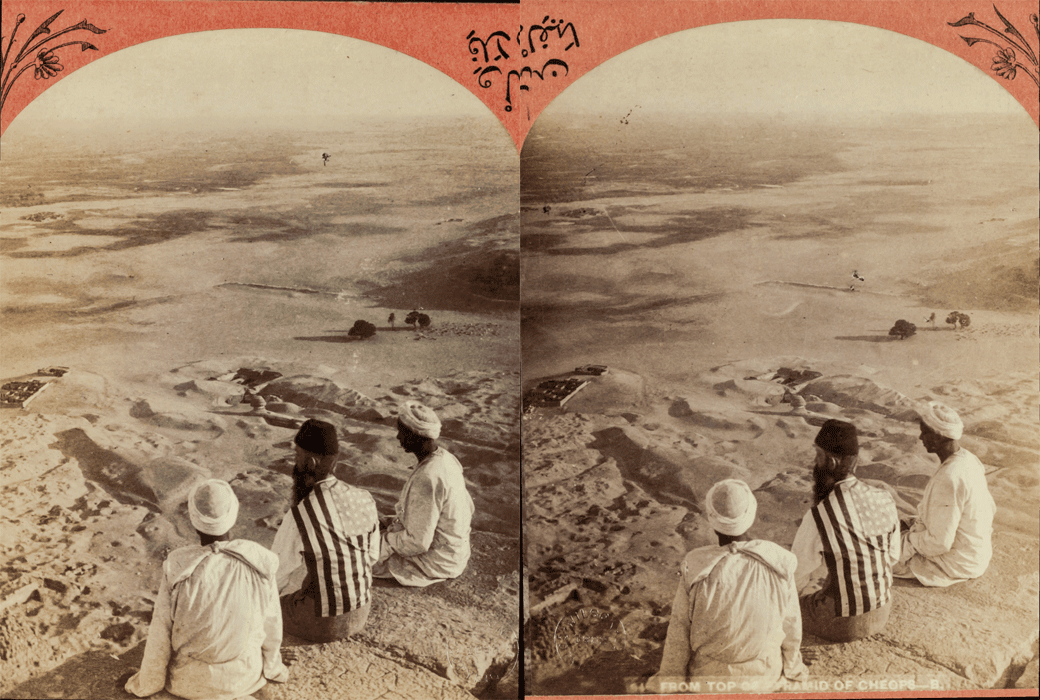
Download a copy of AERAgram 14.1 for more information and become a member today to receive future AERAgrams and help support our work in Egypt.
New Angles on the Great Pyramid
by Glen Dash
(An excerpt from AERAGRAM 13.2)
No monument in the world has given rise to more speculation about its meaning than the Great Pyramid of Khufu. It has been said to encode “God’s unit of measurement”— the Pyramid inch—to physically represent the mathematical constant pi, and incorporate the Golden Section. Sir Isaac Newton thought it could be used to refine his theory of universal gravitation. All of these ideas, sensible or not, depended to one degree or another on knowing the exact size and orientation of the Great Pyramid. It is surprising then to find that there has been no final, definitive work on the subject. The reason is due, in large part, to the condition we find the Pyramid in today. We find scant traces of its original corners. The best we can do is to project their original positions from the fragmentary data that does remain. It has proven to be a challenge. After Mark Lehner and David Goodman measured the base of the Pyramid in 1984, they set the data aside while Lehner undertook the decades long task of uncovering and mapping the Lost City of the Pyramids. I now return to it.
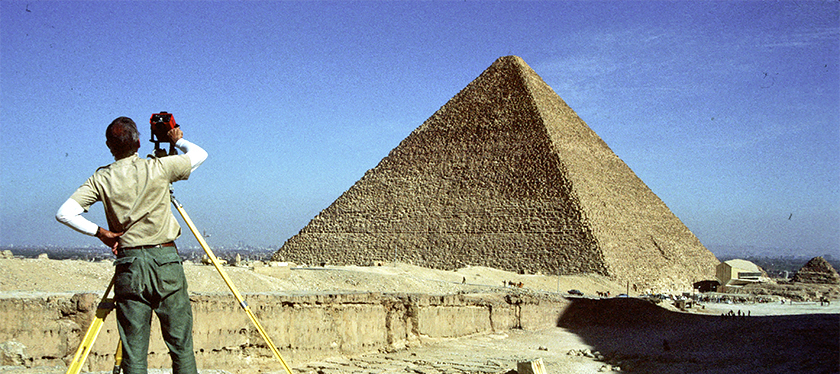
David Goodman surveys in 1984 with a theodolite and electronic distance measuring device to establish the Giza Plateau Mapping Project grid, looking toward the Great Pyramid. Photo by Mark Lehner.
Goodman, a surveyor then with the California Department of Transportation, established the survey grids now used to map both the Giza Plateau and the Valley of the Kings. For this study, he first laid a survey line along each side of the Pyramid between the bronze survey markers left by [Royal Astronomer and surveyor David] Gill, to serve as a control. Lehner then walked along the survey lines, choosing points to measure. When he chose a point, Goodman recorded its distance from one of Gill’s markers electronically. Goodman then sighted along the survey line using his theodolite’s telescope. Lehner laid a tape measure from the point he wished to measure to the survey line, while Goodman, who could see the tape measure in his telescope, recorded the distance between the two. Surveyors refer to these offset measures as “fallings.” At each station, Lehner carefully noted the condition of the edges of the casing and platform stones. Mapping those points where he found the top, outer edge of the platform stones or the lower edge of the casing stones well preserved, I can attempt to reconstruct the original lines of the Pyramid. While previous surveyors had concentrated only on the casing, Lehner measured the platform as well.
In order to analyze this data, I first need to place it on a master grid. The grid I will use is the Giza Plateau Mapping Project (GPMP) control network that was established by Lehner and Goodman in 1984 and 1985. It assigns every point on the plateau coordinates, like addresses for houses on a city map. The origin of the map lies at the calculated center of the Great Pyramid, and everything is measured from that point, in units of meters. Once the Lehner-Goodman data is converted to GPMP coordinates, I can use a standard statistical method known as linear regression analysis to “best-fit” lines to it…
Read this article in its entirety with data charts and visuals, as well as the other featured articles in our AERAGRAM newsletter.
AERA Archives Officially Registered
The AERA Archives are now officially registered with the Library of Congress, recognized as archives and special collections libraries. As part of the registration process, our Boston and Giza Archives were given special MARC Organization Codes, which are used to represent names of libraries and other kinds of organizations that need to be identified in the bibliographic environment.
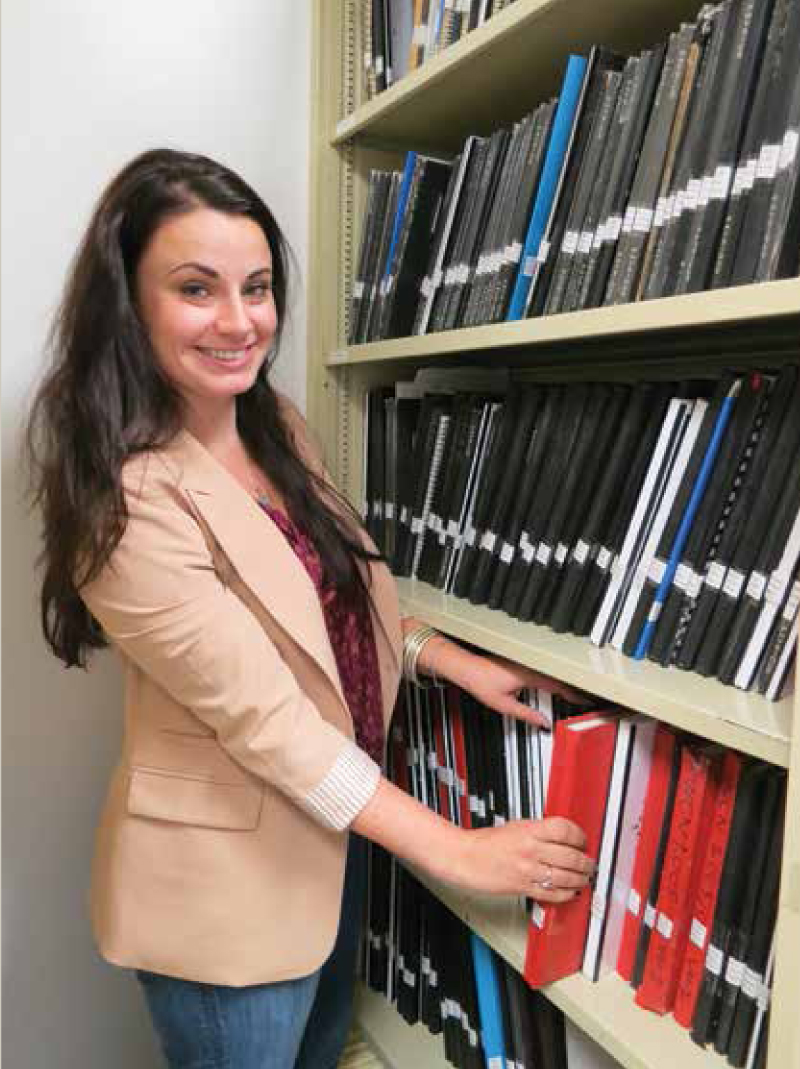
Megan Lallier, MLS, shelves notebooks in the Boston Archives.
These codes are an essential reference tool for systems reporting library holdings, and for those who may be organizing cooperative projects on a regional, national, or international scale. With this recognition, the AERA Archives can be compatible with other library catalogs, making our material accessible when it is open to the public.
Under the direction of AERA Head Archivist Megan Lallier, MLS, our Archives are responsible for ensuring institutional accountability, and for enhancing access to the resources in its care by appraising, acquiring, organizing, describing, making available, and preserving the records of the organization and related documentary materials.
The Archives’ mission is to document the goals and activities of AERA and its contribution of insight and understanding of cultural evolution in Egypt, serving as a primary source of evidence for over 30 years of archaeological investigation in Egypt and as a resource of international significance. The Boston Archive contains originals of over 7,000 drawings including the only scale maps of the Sphinx, approximately 175 linear feet of excavation and specialist data, over 350 notebooks, as well as historic stereoviews, postcards, and photographs. Assistant Archivist Rana Morgan oversees the Giza Archive, which serves as a clearing house for records directly from the field, containing duplicates of all originals to provide access to current and former AERA team members working in Egypt.
Looking ahead, the Archives will be a central component to the intellectual life of AERA, upholding and exemplifying quality, professional access and service to all users while preserving and celebrating its history. Our collections and services will facilitate growth, research, and understanding of AERA and its projects, and will document and highlight its contribution of insight and understanding of cultural evolution in Egypt.
AERA Archaeologist Shares 3-D Scanning With Global Audience

Yukinori Kawae addressing the TEDxKyoto Audience
Kyoto, Japan – On September 16th, Kyoto University hosted a one-day event where 22 individuals shared their knowledge and experience in a wide variety of innovative ideas and practices. The event, TEDxKyoto, designed to inspire the world as presenters shared their passion and success within the areas of technology, entertainment and design (TED).
Among the presenters was Yukinori Kawae, an archaeologist specializing in 3D survey. Yukinori has worked with AERA since 2006 with the launch of our Giza Laser Scanning Survey (GLSS). Using two laser scanners and one laser range finder, Yukinori and his team of surveyors produced detailed three-dimensional model images of monuments such as the tomb of Queen Khentkawes and the Step Pyramid of Saqqara. These images showed all archaeological features such as each stone of the masonry and bedrock fissures and strata. You can read more about GLSS and Yukinori’s work on the Step Pyramid in our GOP 3 and GOP 4 publications.
TEDxKyoto was planned and coordinated within the Kyoto community and independent from TED, a nonprofit organization devoted to “Ideas Worth Spreading”. The TEDx program gives communities, organizations and individuals the opportunity to stimulate dialogue at a local level. In the span of its 26-year existence, TED has stayed true to its mission, bringing together some of the most fascinating thinkers around the world and encouraging them to give the speech of their lives. TED speakers have included Bill Gates, Jane Goodall, Sir Richard Branson and former UK Prime Minister Gordon Brown. Talks are available for free at TED.com.
To view Yukinori’s full TEDxKyoto presentation (Japanese), click here. English scripts will soon be made available for all Japanese presentations.
Visit the TEDxKyoto Facebook page for an in-depth look at the event, including behind the scenes images and commentary, as well as photos and videos of several presenters.

An orthophotographic point cloud image of Khentkawes Tomb
NOVA/Sphinx Encore Presentation
Be sure to catch an encore broadcast of the Writers Guild Award nominated Riddles Of The Sphinx on NOVA, Wednesday May 18th at 9:00 pm on PBS (check local listings).
This documentary, filmed by Providence Pictures producer Gary Glassman, looks to uncover the truths behind some of the biggest mysteries and theories surrounding the ancient statue, and features AERA Director Dr. Mark Lehner as one of the archaeologists looking for answers.
Riddles of the Sphinx debuted on the PBS science program NOVA early last year. Watch it now on Vimeo.
Dr. Lehner Featured in Boston Globe Magazine
AERA Director Dr. Mark Lehner’s brief interview in the February 6th issue of the Boston Globe Magazine. Click on the image to enlarge, or visit the Boston Globe Magazine’s web site at www.boston.com/magazine.
The Wall of the Crow
Heit el-Ghurab
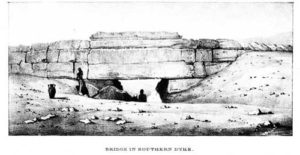
Wall of the Crow gate from Vyse, 1840.
There is a massive, ancient stone wall that stands a few hundreds yards south of the Sphinx. But because it lay partially buried and overshadowed by the pyramids and Sphinx, tourists have hardly noticed it. Known locally as the Wall of the Crow (Heit el-Ghurab in Arabic) it is 200 meters (656 feet) long, ten meters (32.8 feet) high, and ten meters thick at the base.
The Wall is the northwest border of a tract of low desert that we at first designated Area A and later became known as The Lost City of the Pyramids or Heit el-Ghurab (named after the wall’s Arabic name). When we first started our excavations at the Lost City site, we suspected that the Wall of the Crow dated to the Old Kingdom 4th Dynasty (2575-2465 BC), like the Giza Pyramids and the Sphinx, but we did not know why the Egyptians built it. Evidence suggested that they never completed the mammoth undertaking. They never dressed the masonry to produce a finished face to the structure, as was their standard practice with pyramids, tombs, and temple walls.
After further excavations, we can now say for certain that the Wall of the Crow was built as part of our 4th Dynasty (2551-2472 BC) complex and the archaeology has led us to form some ideas as to its function.
Gateway to the sacred?
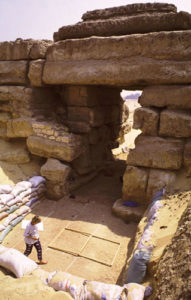
Wall of the Crow gate.
The great gateway in the Wall of the Crow may be one of the largest gateways from the ancient world. It has been visible for the last 4,500 years and yet very little has been written about it. Once we cleared away a thick, sandy overburden, we discovered what an impressive structure the gate is—2.5 to 2.6 meters wide (about 8.5 feet or five ancient Egyptian cubits) and about 7 meters (23 feet) high. Because the base of the Wall is more than 10 meters thick, the gate is actually a short tunnel. The ancient roadway going through the gate was paved with worn or abraded ceramic fragments and laid out with a subtle camber—the sides slope down and away from the center—a common feature of ancient roads.
Along the length of the south side of the wall east of the gate, we cleared a ramp-like slope on the surface of an embankment of limestone chips. This mason’s debris must have been waste from building the wall. It also may have been used as a ramp to drag the massive lintels up over the top of the gate. After placing the stones, the builders left the debris immediately in front of and inside the gate. Upon this debris, traffic formed a path that slopes down 2 to 3 meters (6.56 to 9.84 feet) from north to south. The path passes through the gate to a broad terrace formed of compact sandy masons’ debris that extends at least 30 meters north of the gate.
Function
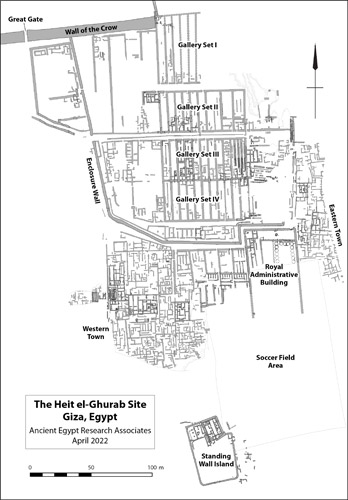
A plan of the Lost City of the Pyramids site. Note the gallery at the east end of the Wall of the Crow.
Why did the builders put so much effort into an immense stone structure that was not part of a pyramid complex nor connected to other structures at Giza? The builders shaped and hauled a huge number of massive blocks to form something more like a dike than a wall. In contrast, the rest of our settlement is mostly built of mud brick or broken stone from the nearby Maadi Formation. The Wall may have separated the sacred precincts of the pyramid plateau from the precincts in which the workers lived. The Enclosure Wall that bounds the Gallery Complex on the west nearly abuts the Wall of the Crow, and the regulated passageways out of the settlement—especially Main Street, the principle axis—led right to the massive gateway in the Wall of the Crow.
In 2002 we found clear evidence that the Gallery Complex (at least Gallery Set I) predated the Wall of the Crow. Until then we were not certain where the Wall ended on the east. The eastern end of the Wall slumped in two layers of large stones, the result of collapse and robbing in late antiquity (we found Late Period burials under the lowest layer of toppled stones). The remains of the gallery walls were about waist to chest-high at the eastern end of the Wall, but about three meters to the east (10 feet), the gallery ruins were cut down to ankle level in a great depression. A massive deposit of granite dust and chips filled this big depression. The granite was from large-scale work nearby, possibly cuttings from the granite casing on the Menkaure Pyramid. But what force cut this depression through the mud brick gallery walls well before the end of the 4th dynasty occupation on our site? Perhaps a flash flood.
Flood control?
Geoarchaeologist Karl Butzer, who studied the environmental history of our site, believes that the 4th Dynasty Egyptians built their settlement on the outwash of a wadi, a stream bed that occasionally carried heavy floods running off the high desert. The Wall of the Crow stands just to the south of the stream bed and could have served to deflect the floodwaters.
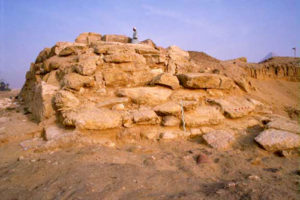
East end of the Wall of the Crow.
If the inhabitants built the massive stone wall for protection against desert flooding, why not extend it across the northern end of the whole Gallery Complex? Perhaps they thought that the thick, mud brick northern wall of Gallery Set I could withstand the wadi floods. The Wall of the Crow might then have been meant to protect the western flank of the Gallery Complex. In fact, an earlier settlement here might actually have succumbed to flash floods. In the lowest layers, those predating the Gallery Complex, we found settlement debris—mud bricks, pottery fragments, and limestone rocks—mixed with mud and pebbles washed down from the natural gravel in the high desert. We continue to look for evidence to support a hypothesis that the Wall may have served as flood-control to protect the workers settlement.
Sacred structure
Late Period burials sprawl in a large cemetery across the northwestern portion of our site, with grave upon grave cut into the Old Kingdom deposits. Toward the eastern end of the Wall of the Crow, the graves increase in density like the epicenter of a galaxy.
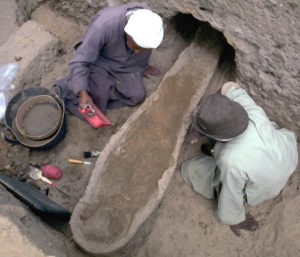
Burial at Wall of the Crow.
The Late Period (747-525 BC) residents of nearby towns must have considered the area around the Wall of the Crow as sacred ground. The burials extend right up to the east end of the Wall, with some of the dead interred in the sand above rocks that tumbled from the Wall. These burials post-date the collapse of the eastern end of the Wall. Caches of animal bone that we encountered in the same sand layer as some of the nearby Late Period burials are another sign of the Wall’s sanctity. One cache included two skulls—from a bovine and a smaller animal, possibly a goat. Another cache contained two cattle skulls. In the spring of 2000, when we began clearing the southern side of the Wall of the Crow near the east end, we encountered a third cache—a bovine skull and a Late Period amphora tucked into a niche between the blocks of the Wall.
Child burials
Next to the eastern end, the percentage of child burials is higher than in other areas: 60% compared with, for example, 27% in a nearby square. Many of these children were adorned with jewelry and amulets, while adult burials contained no grave accoutrements. We do not yet understand the significance of these special child burials.
The Wall of the Crow today
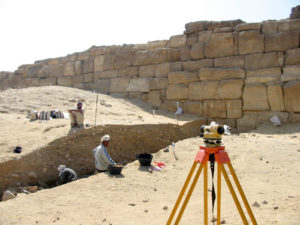
Archaeologists working at the Wall of the Crow.
The area around the Wall of the Crow is still a burial ground. An Islamic cemetery engulfs the west end of the Wall and a Coptic Christian cemetery lies just south of it. During funerals, the deceased is carried in a procession through the great gate in the Wall. It is possible that this part of our site was a burial ground from late Roman to early Christian times. The first Muslim graves, the tombs of sheikhs (learned Muslim men), were built north of the west end of the wall. Both cemeteries—Coptic and Muslim—have wells; water sources are often associated with sacred traditions.
The Wall of the Crow is also still associated with fertility even today. Until recent years, women hoping for children would squat near a nail (a bronze survey peg pounded into the Wall by a surveyor many years ago), and then walk around the raised limestone blocks seven times. Through the millennia that the Wall of the Crow has laid half-buried, it has maintained its sacred aura and perhaps become even more mystical. We certainly look in awe upon this massive structure poised between the worlds of the living and dead, both ancient and modern.